If you’re trying to figure out how to manage multiple blogs, the standard advice is to not do it. Focus on one site, build authority, scale from there. That advice assumes the only tool available is human time, which is finite and non-compressible. It’s the right advice for that constraint. It stops being right when AI enters the operation not as a writing shortcut but as infrastructure, the layer that handles the parts of the operation that used to require either a team or a decision to leave things undone.
Running six sites across different niches, publishing to multiple platforms, and maintaining a consistent content pipeline without staff is not a productivity hack. It’s a systems problem, and AI is what makes the system solvable at one person’s scale.

Why Multiple Blogs Break Without a System
The failure mode for solo multi-site operators isn’t running out of ideas. It’s operational drag. Each site needs content researched, drafted, edited, published, and distributed. Each platform has its own formatting requirements, its own character limits, its own quirks. Do that manually across six properties and the math doesn’t work even if you’re fast. Something always gets deprioritized, and deprioritized sites go quiet, and quiet sites lose whatever momentum they had.
The other failure mode is context switching. Moving between a QA automation blog, a wellness site, a remote work property, and an AI tools site in the same day requires shifting voice, topic depth, and reader assumptions every time. Without a system that handles the mechanical parts of each transition, the cognitive load accumulates and the quality drops. You stop publishing because starting feels too heavy, not because you have nothing to say.
A system doesn’t eliminate the work. It redistributes it so the work that requires your judgment gets your judgment, and the work that doesn’t gets handled by something that doesn’t get tired.
Where AI Actually Fits
AI fits in the operation at the points where the work is mechanical, repetitive, or generative without requiring lived experience. That’s a specific and limited set of tasks, and being honest about the boundary is what separates a functional AI workflow from a content farm.
Drafting is the obvious entry point but it’s the most misunderstood one. AI doesn’t replace the writing. It handles the first pass on structure and coverage so the editing pass starts from something rather than nothing. The difference between editing a draft and writing from a blank page is not marginal — it’s the difference between thirty minutes and two hours per post. That compression, multiplied across six sites and dozens of posts per month, is where the operational leverage actually lives. If you want to understand the AI writing leverage that makes this worthwhile versus what it can’t do, that distinction is worth reading before building anything.
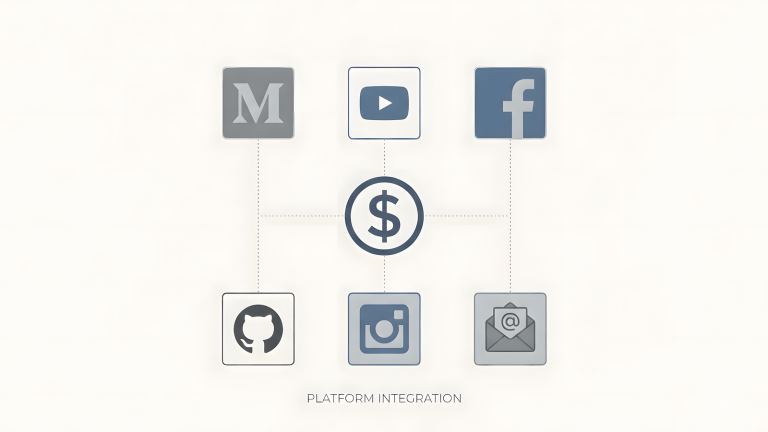
Distribution and syndication are where AI and automation earn their keep most cleanly. Publishing a post on WordPress is one task. Getting that post to Medium, LinkedIn, Substack, Facebook, and Dev.to with platform-appropriate formatting is five more tasks per post per site. Automating that layer with tools like n8n and Playwright turns a half-day of manual publishing into a triggered workflow that runs while you’re doing something else. This is not AI writing your content. This is AI and automation handling the logistics so you’re not doing the same copy-paste operation forty times a week.
Trend monitoring and topic sourcing also compress well with the right setup. RSS feeds from Google Trends and relevant subreddits, piped into a workflow that surfaces the signals worth acting on, means you’re not manually scanning ten sources every morning to find what’s worth writing about. The curation still happens at the human layer. The data collection doesn’t have to.
The Workflow Layer by Layer
The drafting layer starts with a topic and a focus keyphrase locked before anything is generated. The AI produces a structured draft against that brief. The draft goes through an editorial pass that adds personal experience, corrects tone drift, removes anything that reads like it was produced to fill space rather than inform a reader. Nothing publishes from the AI layer directly. Everything goes through the editorial layer first, and the editorial layer is entirely human.
The publishing layer is handled by an Express server running platform-specific Playwright scripts that log into each platform and execute the post. Each site has its own authentication context. Each platform has its own script. The n8n and Playwright automation setup on EAI covers how that layer is actually built if you want the technical implementation. The whole stack runs on a local machine with pm2 keeping the processes alive. It’s not elegant infrastructure but it works reliably and costs nothing beyond the time it took to build it.
The distribution layer runs on n8n workflows that chain the publishing tasks in sequence with wait intervals between them to avoid triggering rate limits or shared account conflicts. The master workflow kicks off site-specific subworkflows in order. The n8n content syndication automation breakdown covers how those workflows are structured end to end. By the time the first cup of coffee is finished, posts are live across platforms that would have taken a full morning to publish manually.
The monitoring layer is the lightest part of the stack. Google Search Console across all six sites, AdSense for the monetization signal, and periodic sitemap checks to catch indexing issues before they compound. None of this requires AI. It requires a habit of looking at the right numbers on a regular schedule.
What the Human Layer Still Owns
The editorial judgment is non-delegable. Topic selection, keyphrase locking, angle decisions, editorial additions, quality calls, all of it stays at the human layer. AI produces the surface. The operator decides what’s worth keeping, what needs rewriting, and what gets cut. A post that reads like a practitioner wrote it does so because a practitioner edited it, not because the generation prompt was clever enough.
Voice consistency across six sites with different tones and different readers requires active maintenance. Each site has a voice document that defines how it sounds, what it doesn’t say, and what the reader assumes coming in. Keeping that consistent across a high-volume pipeline is an editorial discipline, not a technical one. The system handles the volume. The editor handles the character.
The relationship with the reader is also human. Responding to comments, making judgment calls about what the audience needs next, recognizing when a site is drifting from its identity none of that is automatable. The system creates the surface area. The operator decides what it means and where it goes.
What It Actually Took
This stack wasn’t built in a weekend. The publishing automation alone required learning enough about browser automation to write reliable Playwright scripts, enough about Node.js to run an Express server, and enough about n8n to chain workflows without them collapsing on each other. The lessons from building an autonomous AI publishing pipeline on EAI documents what that process actually looked like, including what broke before it worked. The drafting workflow required enough prompt engineering discipline to get consistent output worth editing rather than output worth discarding.
The honest version of how to manage multiple blogs with AI is that the AI doesn’t manage anything. You build a system, you maintain it, you edit everything it produces, and you make every decision that matters. What AI and automation do is compress the mechanical work enough that one person can run an operation that would otherwise need three. That’s the actual value proposition, and it’s significant enough without overstating it.
The system is the product. The blogs are what the system produces. Getting that distinction right is what separates a functional multi-site operation from a content graveyard with good intentions.