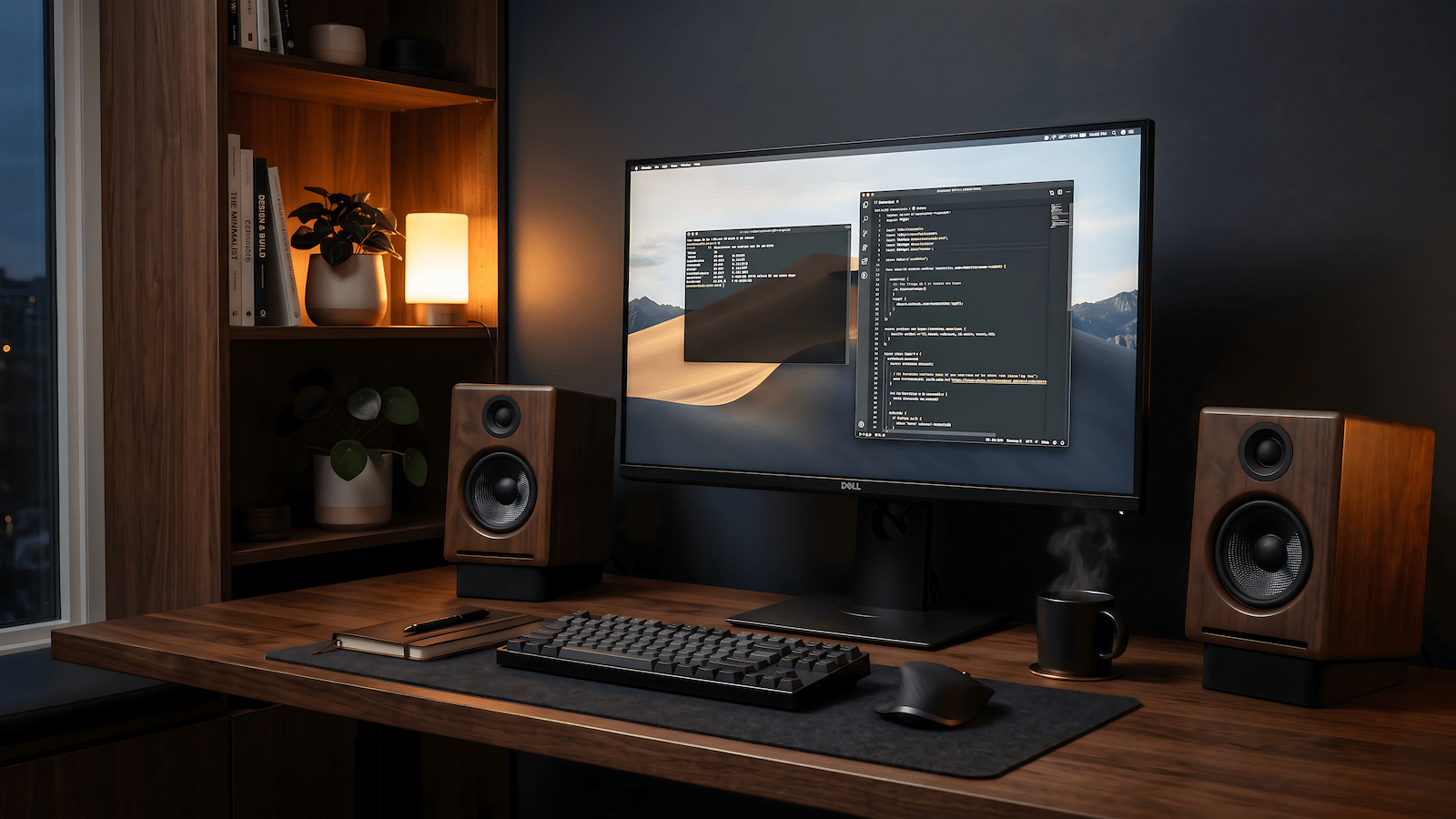
Most remote workers have their home office audio setup handled on one level. There’s a headset on the desk, a USB mic plugged in, something that makes you audible on a call without sounding like you’re broadcasting from a parking garage. That problem is solved. What nobody talks about is the other audio problem: the eight to ten hours you spend in that room when you’re not on a call, and what you’re actually listening to while you work.
Those are two different problems. Most home offices only solve the first one.
The Two Layers of Remote Work Audio
The functional layer is call audio. Your microphone input, your headset output, the quality of what other people hear when you speak and what you hear when they do. This layer has been thoroughly covered. Every remote work guide has a section on microphones and headsets. The market is full of options at every price point and most of them work well enough.
The quality of life layer is everything else. It’s the speaker on your desk when you’re deep in a task and need music to focus. It’s the sound of your room when the call ends and you’re back to working alone. It’s the difference between spending eight hours in a space that sounds good and spending eight hours in a space that sounds like a bus terminal. This layer gets almost no attention in remote work content, which is strange because it directly affects your mood, your focus, and your ability to stay in a room for long stretches without losing your mind.
A cheap Bluetooth speaker solves the problem the same way a gas station sandwich solves hunger. Technically true. Not actually satisfying.
Why Most People Stop at Layer One
The functional layer has an obvious failure mode. If your microphone sounds bad, people tell you immediately. The feedback loop is instant. You fix it. The quality of life layer has no such feedback loop. Bad ambient audio just slowly degrades your experience over months until you either stop noticing or start dreading going into your office. Neither outcome shows up in a productivity metric so it never gets prioritized.
There’s also a cost perception problem. People will spend three hundred dollars on a monitor arm without blinking because it’s clearly a productivity tool. A good speaker feels like a luxury, something you justify after everything else is sorted. If you’ve ever looked at your desk and realized the one thing you haven’t properly addressed is what it actually sounds like to sit there all day, you’re not alone. The result is that the audio environment gets the budget that’s left over, which is usually nothing.
What Bad Ambient Audio Costs You
This isn’t about audiophile snobbery. It’s about physics and attention. A speaker with poor frequency response, thin on bass and harsh in the mids, forces your brain to work harder to extract musical information from a distorted signal. You don’t notice it consciously but you feel it as fatigue. The music that’s supposed to reduce cognitive load ends up adding to it.
There’s also the room relationship. A decent speaker fills a space. A bad one sits in a corner making noise. When audio fills a room properly you stop being aware of it as a separate element and it becomes part of the environment. That’s the state you want for sustained focus work. A tinny Bluetooth speaker on the corner of your desk keeps reminding you it exists every time it compresses a transient or clips a frequency. The same way your physical workspace shapes how long you can stay focused and operational, your audio environment either supports or erodes that state across the full day.
Over a full workday this compounds. Eight hours of slightly fatiguing audio is not the same as eight hours of good audio. Anyone who has worked in a well-treated room with a real speaker system and then gone back to laptop speakers knows exactly what this gap feels like.
What Good Audio Actually Looks Like
Good home office audio doesn’t require a dedicated listening room or a five-figure system. It requires solving the right problem at the right budget. The categories worth thinking about are desktop speakers, over-ear headphones for focused work, and for those who want to go deeper, a DAC and amplifier to drive them properly.
Desktop speakers are the anchor. A pair of powered bookshelf speakers designed for near-field listening at a desk will outperform any Bluetooth speaker at the same price point simply because they’re engineered for that use case. Brands like Edifier, Klipsch, and KEF make options across a wide price range that are genuinely worth the money. You don’t need to spend a thousand dollars. You need to spend enough to get out of the range where compromises start showing up in the sound.
Over-ear headphones solve a different problem. When you need to focus in a noisy environment, or when the work requires the kind of concentration that a shared space makes difficult, a good pair of closed-back headphones creates an acoustic environment that belongs entirely to you. This is different from noise-canceling headphones designed for travel. For desk work you want something that sounds right, not just something that blocks sound. This matters especially if your home office doubles as your gear room, your focus space, and the place where you decompress at the end of a shift.
The DAC and amplifier category is for people who already know they care about this. If you’re driving a pair of quality headphones from a laptop headphone jack you’re leaving performance on the table. A USB DAC handles the digital to analog conversion outside the electrically noisy environment of your computer and makes a measurable difference. This is the entry point to the serious end of the spectrum and it doesn’t have to be expensive.
The Longevity Argument
Here’s the thing about good audio gear that nobody mentions in remote work content: it lasts. A Bose Roommate speaker from the early 90s still works. Still sounds good. Still sits on a desk and fills a room the way it was designed to. That’s over thirty years of daily use from a single purchase. The cheap Bluetooth speaker you bought three years ago is already in a drawer or dead from a swollen battery.
This reframes the cost calculation entirely. A three hundred dollar pair of powered bookshelf speakers amortized over ten years of daily use is a rounding error. A fifty dollar Bluetooth speaker you replace every two years is more expensive and sounds worse every day you own it. The premium for quality audio gear isn’t a luxury tax. It’s the cost of not buying the same bad product six times.
Good gear also holds its value. Vintage audio equipment from reputable manufacturers trades actively on the used market because the engineering was done right the first time and the components were built to last. You can buy a used pair of quality bookshelf speakers from fifteen years ago and they will outperform new budget options without question. The home office audio setup that costs real money today becomes an asset, not a sunk cost.
Where to Start
If your current setup is a laptop speaker or a budget Bluetooth speaker, the highest impact upgrade is a pair of powered bookshelf speakers. Get them on desk stands or isolator pads so they’re at ear level and not firing at your chest. Connect them via a proper cable to your computer’s audio output or through a USB DAC if you want to do it properly. That’s a complete near-field listening setup that will serve you for years and it fits on the same desk you’re already using as your control room.
If you already have decent speakers and want to improve the headphone side, a closed-back pair of over-ear headphones designed for studio or home listening paired with a USB DAC is the move. You’ll notice the difference immediately on anything you’ve listened to a hundred times. Pair that with a clean signal desk setup and the acoustic and visual environment of your workspace start working together instead of against each other.
The functional layer of your home office audio setup was always just the floor. The ceiling is considerably higher, and spending a full workday closer to it makes a difference that shows up not in your call quality but in how you feel at the end of eight hours in a room.