Some links on this page are Amazon affiliate links. If you choose to buy through them, RemoteWorkHaven may earn a small commission at no extra cost to you.
These links only appear where tools or setup gear naturally fit the topic. No paid placements. No brand endorsements.
The chair comparison content you’ll find online is almost universally written by people who tested each chair for twenty minutes in a showroom or received one for free and wrote about it after a week. Long-hour remote workers and people who game four to six hours a session need a different kind of answer, because the problems that matter only show up after the second or third month of daily use.
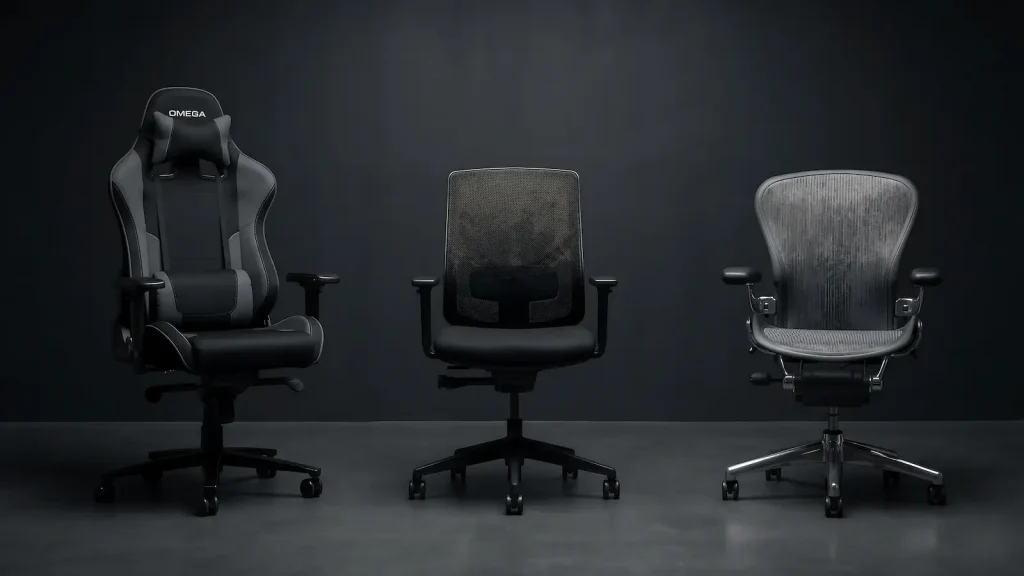
Here’s what actually separates these categories and what to buy at each budget on right now.
Gaming Chairs: The Honest Assessment
Gaming chairs sell the feeling of serious equipment. The bucket seat, the aggressive recline, the racing aesthetic, it all signals that this is purpose-built gear. The design language comes from motorsport seats, which are engineered for lateral support under high-G cornering forces, not for eight hours of upright desk work. The deep bolsters push your shoulders forward. The narrow seat pan is uncomfortable for most adult body sizes past the two-hour mark. The lumbar pillow that ships in the box is not adjustable in any meaningful way and ends up in a drawer.
Budget gaming chairs compound this with materials that fail fast. Faux leather cracks within a year, especially in humid climates. Gas lift cylinders fail. Armrests stop adjusting. You bought a chair that looks like equipment and performs like furniture.
The exception is the Secretlab TITAN Evo, which sits above the typical gaming chair category in actual build quality. The lumbar system is a proper adjustable mechanism, not a pillow strapped to the back. The seat foam density holds up over time. The recline range is genuinely useful for gaming sessions where you want to lean back. It’s one of the few gaming chairs where the money goes into the engineering rather than the aesthetics. If gaming aesthetics matter to you and you want a chair that holds up, this is the tier to buy at. Below this tier, you’re paying for the look.
Office Chairs: Where Durability Lives at the Mid Range
Mid-range office chairs built for corporate environments are designed to a different specification than gaming chairs. The mechanisms are more robust because they’re rated for commercial use. The adjustment range is wider. The materials hold up under daily use because failure in a commercial setting is a liability problem.
The SIHOO M18 sits at a practical price point with a mesh back, adjustable headrest, adjustable lumbar support, and a seat cushion that doesn’t pancake after three months. It’s not glamorous but it solves the durability and adjustability problems that kill budget gaming chairs. The GABRYLLY Ergonomic Office Chair is another solid option in this tier with a high back, flip-up arms, and a wide cushion that accommodates larger frames better than most gaming chairs at the same price.
The Colamy Hina has been getting consistent recognition from testers who buy and actually use chairs for extended periods rather than reviewing them after a week. It delivers build quality that punches above its price tier, check current Amazon pricing for exact cost. The lumbar mechanism adjusts properly rather than just moving a pillow around, and the materials feel like they’ll survive two or three years of daily use rather than one.
The limitation of this tier is that “ergonomic” is used loosely. Check three things before anything else: adjustable lumbar position, seat depth range, and whether the armrests adjust in more than one axis. If all three are present, the chair will work for long hours. If any are missing, you’re going to fight it.
Ergonomic Chairs: The High End Benchmark
The Herman Miller Aeron is the reference point for what this category is actually trying to do. The mesh back conforms to your spine’s natural curve rather than pushing a fixed support into one point on your back. The PostureFit SL system supports both the sacrum and lumbar simultaneously. It comes in three sizes which A, B, and C so fit is addressed at the product level rather than left entirely to adjustment. Herman Miller doesn’t sell through Amazon, but the Aeron is worth understanding because it defines what a properly engineered chair actually does.
For options in the high-end tier, the Marsail Ergonomic Office Chair with 3D armrests and adjustable lumbar is a legitimate option for buyers who want serious adjustability without leaving the platform. The TRALT, currently one of the best-selling office chairs, has earned that position through consistent reviews from actual long-term users rather than launch-day hype. At its price point it delivers adjustable lumbar, mesh breathability, and a build that holds up better than most in its class.
If your budget extends to $300 and above, the Ticova Ergonomic Chair appears consistently in independent long-term testing as one of the better options typically found with coupons that bring the price down meaningfully, which makes it one of the stronger value positions in the category.
The Fit Problem Nobody Mentions
Chair category matters less than chair fit. A well-fitted mid-range office chair outperforms a poorly-fitted high-end ergonomic chair every time. Before buying anything, check three measurements against the chair’s spec sheet: your sitting height, your thigh length from knee to seat, and your preferred desk height. If your feet don’t rest flat on the floor in the chair at your desk height, add a footrest, it’s a cheap fix that changes the entire equation regardless of which chair you’re in. If the lumbar hits your mid-back instead of your lower back, it’s actively pushing you into worse posture than no support at all.
Mesh versus leather is also not an aesthetic choice if you’re in a warm climate. Eight hours a day in a leather or faux-leather seat in tropical heat is a comfort problem that compounds every hour. Mesh wins on breathability and it wins harder in hot environments. Every chair recommendation above uses mesh for this reason.
The Actual Recommendation by Use Case
For gaming-first use where aesthetics matter: Secretlab TITAN Evo, nothing below that tier. For remote work on a budget under $200: SIHOO M18 or GABRYLLY, fitted to your body dimensions. For remote work with a $200 to $300 budget: Colamy Hina or Ticova. For serious long-hours use where the chair is infrastructure: find a used Herman Miller Aeron locally if possible, or go Ticova. Add a footrest if your feet don’t reach the floor flat. Everything else is optional.