
Every remote team management guide tells you to build trust, communicate clearly, and set expectations. None of them tell you what to do when the tool or process you picked in good faith turns out to be the thing quietly eroding that trust, especially when nobody’s in the same room to catch the friction early. That gap, between advice written in the abstract and decisions made under real constraints, is where most remote team management actually breaks down.
The advice keeps failing because it is almost always written from one seat only, either the person making the call or the person living with it, never both. Judgment about remote teams looks completely different depending on which side of that line you are standing on, and most guidance never accounts for the other side at all. It’s the same seat-change most QA engineers face going from tester to lead, the job doesn’t just get bigger, the whole vantage point changes.

What a Decision Looks Like From the Seat That Makes It
My remote team had built years of habit around Pivotal Tracker, stories organized under epics, a working backlog and icebox, and velocity tracking that told us how we were actually pacing, all the more important without anyone sitting in the same office to informally check in on how the sprint was actually going. When Pivotal Tracker’s end of life started coming into view, I went looking for alternatives. Both Taiga and GitHub Issues came up in that search, but I wasn’t personally used to working in GitHub Issues, and that unfamiliarity made it the harder migration path for me to lead the team through, so Taiga became the choice.
Taiga seemed reasonable going in, and using it day to day was fine at first. What became clear only after the team had been running on it for a while was what it didn’t have, no epic layer above stories, and no velocity tracking, both pieces of how we’d measured our own pace under Pivotal Tracker. The team called it out directly on our private channel, not behind my back, that’s just how we operated, say what you actually think, and I took a real burn for the decision. I needed that. I was wrong about the tradeoffs going in. Every QA lead eventually faces a call like this, one where the reasoning was sound and the outcome still went sideways.
The devs pushed two alternatives once the gaps were out in the open, Trello, or going to GitHub Projects instead. Moving to either of those, or to Linear, would have closed the gap, but the project was already nearing MVP, and a migration that late carries its own cost, retraining habits, re-mapping the backlog, losing momentum right before the finish line. Weighed against that, staying on Taiga and working around what it lacked was the cheaper call, even with the tradeoffs still sitting there unresolved.
Looking back, Linear would probably have been the easier fit from the start. That’s not a knock on Taiga, Taiga does what it does fine. It just wasn’t built around epics and velocity the way my team’s whole workflow was, and Linear’s structure would have matched that closer from day one.
What the Same Kind of Decision Looks Like From the Other Seat
Long before I was making calls like that, I was on-site as senior team support at a BPO inside a Salesforce setup I had no hand in choosing. That job wasn’t remote at the time, but the same access problem plays out constantly in BPO and admin-support work now that so much of it has moved remote since the pandemic, the person furthest from the system’s configuration is usually the one most stuck with whatever access they were handed, whether they’re sitting in a cubicle or working from home. I couldn’t adjust what fields were shown or hidden, and I couldn’t set up a dashboard around how I actually worked. That access sat entirely with whoever administered the system, and there was nothing wrong with Salesforce itself, the limitation was how much control I had over it.
A separate, fully remote job showed me what the other side of that looked like. That team ran on Jira, and my access there wasn’t locked down the way it had been on Salesforce. I could build my own dashboard around how I actually worked, and that one difference made the daily work noticeably easier, not because Jira is inherently a better tool, but because I had a real say in how it worked for me.
A former colleague from that same BPO era, who later moved into real estate, lived through a version of the same dependency as part of an admin team there. Their Salesforce setup worked fine until the person who administered it left, and without anyone able to reconfigure it, the system started breaking down in ways the rest of the team couldn’t fix themselves. They moved to Zapier just to keep things running until someone who could maintain Salesforce properly came back on board. Salesforce was never the problem in either story. The problem both times was how much control sat with the people actually doing the work, and how fragile that control was when it depended on one specific person staying in place. It’s the same asymmetry covered from the other direction in what a task dump actually communicates versus what it doesn’t, the person closest to the work usually has the least say in how that work gets structured.
What the Decision Actually Turns On
None of these situations came down to a tool being right or wrong. Pivotal Tracker’s replacement needed to match a workflow built around epics and velocity, and Taiga didn’t, not because it’s a weak tool, but because it wasn’t built for that shape of work. Salesforce needed someone with the access and the skill to keep it configured for the people actually using it, and when that access wasn’t there, either because it was locked down from the start or because the one person who held it left, the system stopped serving the team regardless of how solid the software was underneath.
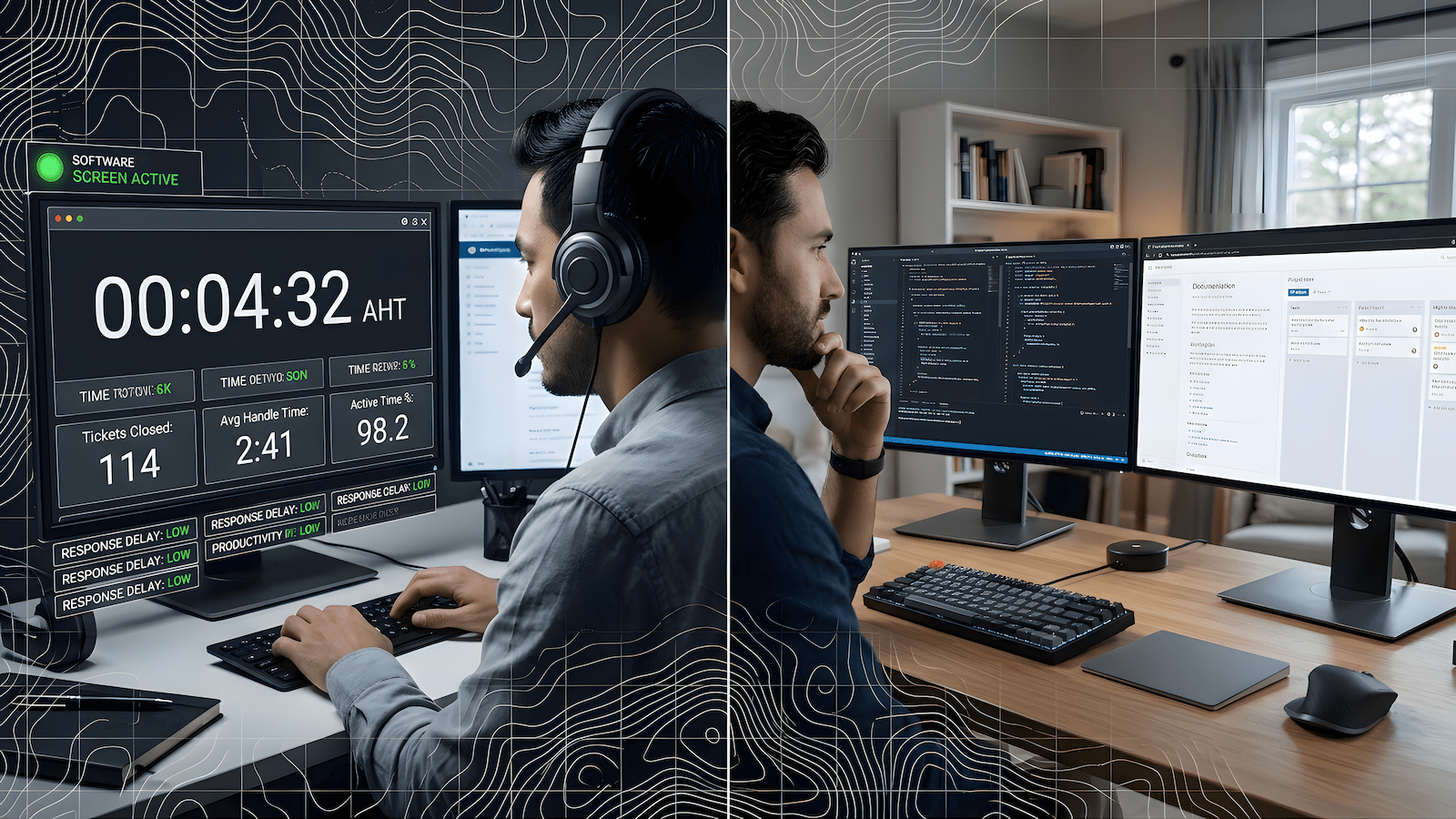
That’s the real judgment call in remote team management specifically, not which software wins a comparison, but whether a decision accounts for how a team that’s never in the same room together already works, and whether the people doing that work have enough control and support to keep it running without anyone physically around to notice when it’s not. It only becomes visible once you’ve stood on more than one side of a decision like this, made the call and watched it strain, or lived inside someone else’s call with no say in fixing it. It’s the same distinction between metric-based and trust-based management that determines whether a remote team actually holds together or just looks like it does on a dashboard.
Some teams eventually formalize this into dedicated remote team management software once ad hoc tools stop scaling. That transition tends to go smoother when it follows the same judgment, matching the choice to the team’s actual working habits and the access the people using it actually have, rather than picking whatever looks best on a comparison page.