There is a version of bathroom break remote work etiquette that everybody practices and almost nobody discusses out loud. It lives in the gap between your green dot and your grey dot, in the BRB you post to a group chat without explanation, in the low-grade anxiety of being pinged while you’re away from your desk doing something your body requires. Remote work made presence a visible, logged, accountable thing. And somewhere in that shift, taking a shit became a workplace event that apparently needs management.
This is not a minor friction point. It touches everyone on an async-first team, every day. The fact that it stays unspoken doesn’t mean it’s not shaping how people work, how women in particular navigate professional visibility, and how managers read availability. It just means nobody’s written the etiquette down in a way that actually reflects how people behave.
What the Office Got Right Without Trying
In a physical office, you stood up and walked away. Nobody needed a status update. If someone came to your desk and you weren’t there, they came back. The social contract was loose, implicit, and mostly fine. Short absences were invisible because presence itself was ambient and assumed. You were either at your desk or you weren’t, and both states were low-stakes.
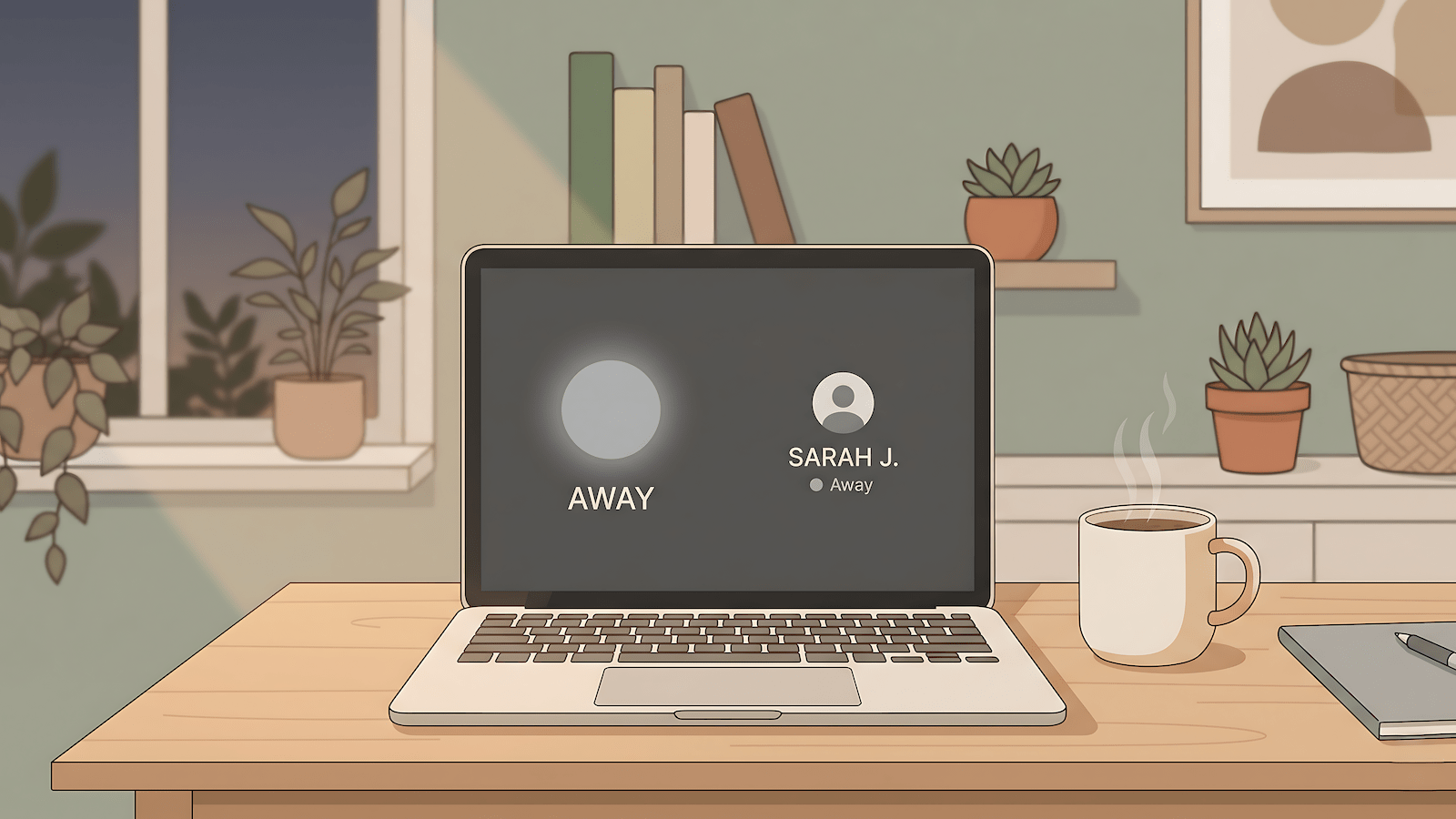
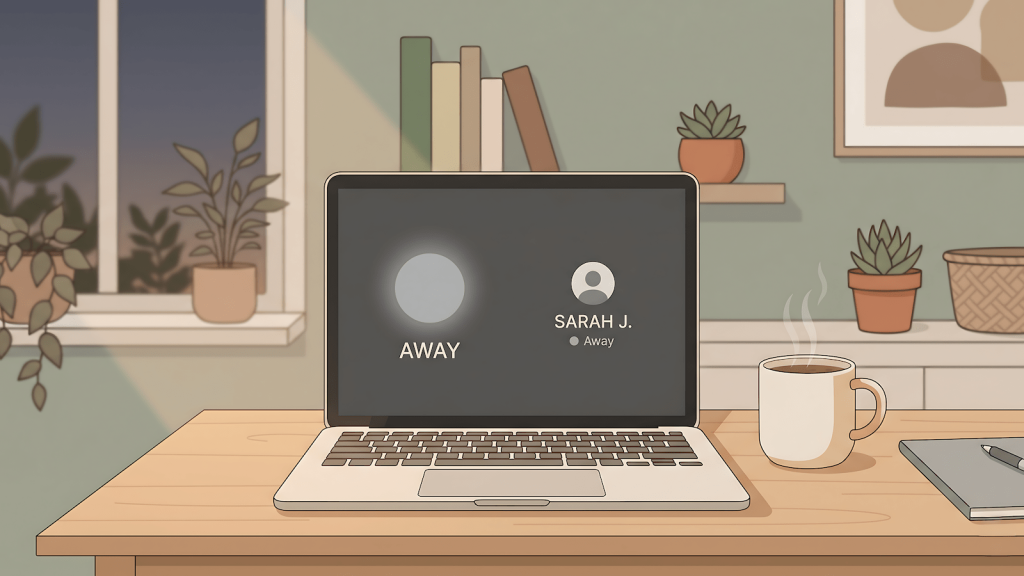
Chat changed that geometry completely. Now presence is a boolean. You’re green or you’re grey. You’re Available or you’re Away. The default assumption in most async team setups is that a green dot means you’re responsive, and a grey dot requires an explanation. That’s not a policy most companies write down. It’s just what the interface implies, and people internalize it fast. A three-minute bathroom break in this model becomes a visibility event with optional documentation.
The absurdity holds up under examination. Nobody expects a surgeon to ping the OR team when they step out between procedures. Nobody expects a warehouse worker to log a bio break in Slack. But a remote knowledge worker with a green dot is implicitly on record, and any deviation from that record is a potential data point for whoever’s watching.
The Vocabulary We Built to Avoid Saying the Thing
The async workplace developed a genuinely interesting workaround vocabulary. BRB. AFK. Bio break. Stepping away. Grabbing coffee. Number two, for the particularly brave. None of these say the thing directly. All of them mean the thing, at least some of the time. The function of these phrases is to signal a brief availability disruption without triggering the part of the professional brain that categorizes bodily functions as inappropriate workplace conversation.
BRB is the cleanest option because it’s maximum vagueness with minimum commitment. It says: I am temporarily unavailable, I will return, no further questions. It doesn’t specify duration. It doesn’t invite follow-up. It handles a bathroom break exactly as well as it handles the doorbell, the printer jam, or the child who just appeared in the doorway. BRB is load-bearing ambiguity, and for most situations it’s the correct answer.
“Bio break” occupies a strange middle ground. It’s clinical enough to feel professional, obvious enough that everyone knows it means you’re taking a dump, and somehow worse than either saying nothing or just saying the plain thing. It has the energy of a corporate memo about hydration. It signals that the speaker is aware of the awkwardness and is choosing a euphemism, which somehow draws more attention to the underlying act than honest language would. If you’ve ever typed “bio break” into a group chat and felt slightly ridiculous, that instinct was correct.
The Gender Gap Is Real and It’s Operating in Your Team Right Now
Women in remote and async work environments are significantly less likely to announce brief absences directly than men are. This is not a fringe observation. It shows up in how women phrase status updates, in how they frame short unavailability to supervisors, and in the specific language they choose when they do communicate a break. The default is vagueness, which is not a personal quirk or a failure of confidence. It’s a learned response to a documented double standard.
In physical office culture, men have normalized announcing they’re going to take a dump in ways that register as casual and unbothered. It’s locker room behavior that migrated into the workplace without friction. Women face a different social calculus. Bodily functions for women carry an expectation of discretion that doesn’t apply to men, and violating that expectation, even mildly, can register as oversharing in professional contexts. So the options narrow down to: say nothing and look unresponsive, use vague language and hope no one presses, or be direct and absorb the social cost of having said the plain thing. This dynamic shows up clearly when you look at how cultural differences shape remote team communication the disclosure gap isn’t just gendered, it’s also cultural.
The third option is functionally the most honest and often the least disruptive. But it requires a level of comfort with professional self-disclosure that most workplaces haven’t earned from their employees, and that women especially haven’t been given permission to exercise.
When Saying the Thing Actually Works Better
There’s a version of direct disclosure that reads not as oversharing but as unbothered professional confidence. “Taking a quick break, back in five” sets a clear expectation and closes the loop. It doesn’t require elaboration. The person on the other end knows you’re a human being with a functioning digestive system, and that information does not damage your professional standing unless your workplace is genuinely broken.
The practical upside of being more direct is that it eliminates the interpretive ambiguity that vague status updates create. A grey dot or a silent BRB leaves the reader guessing: is this person gone for two minutes or two hours? Are they ignoring messages or just unavailable? That uncertainty has a real cost, particularly when a supervisor or client is on the other end. This is the same friction that drives the looking busy versus actually being available problem the signal is ambiguous, so people fill the gap with the worst interpretation. A brief, plain-language status gives the team something to work with that BRB sometimes doesn’t.
The Practical Framework That Actually Holds Up
For short breaks under ten minutes, BRB or a custom status with an estimated return is all that’s required. Nothing more should be expected. The green dot is an availability signal, not a surveillance tool, and treating it like the latter is a management problem, not a communication problem. If your team culture has drifted into treating every grey dot as a performance issue, that’s worth reading alongside the broader conversation about remote work discipline and what job security actually looks like in async environments.
For absences that extend past ten to fifteen minutes, switching to Away or Do Not Disturb with an ETA is the cleaner option. It sets an honest expectation and removes the anxiety of watching a green dot go silent mid-conversation. It also protects the worker from the inference that silence equals avoidance, which is the exact wrong read of someone who stepped away to take a shit and came back five minutes later to seventeen unread messages.
For supervisors and team leads, the norm worth modeling is proportionality. If someone’s grey dot creates friction on your team, the problem is the expectation, not the person. Async work exists precisely to reduce the pressure of synchronous availability. If a three-minute absence is a performance concern, that’s a culture conversation, not a chat status conversation. And if you’re the kind of manager who tracks green dots, you should read about why micromanagement kills team momentum before your next one-on-one.
The gender dimension deserves a direct callout here. If the women on your team are consistently using more evasive language around absences than the men, consider what the environment is communicating to them. The workplace didn’t give them permission to be direct. That’s something team culture has to actively build, and it starts with the people setting the norms not treating “I’ll be back in five” as something that requires a cover story.
The Status Indicator Cannot Replace a Sane Norm
The broader issue with bathroom break remote work etiquette is that it was never written down because it seemed too small to formalize. But small norms compound. The anxiety of the green dot, the performed awkwardness of “bio break,” the gender gap in who gets to speak plainly about basic human functions these are not separate problems. They’re the same problem at different levels of visibility.
Remote work created a presence infrastructure that nobody fully thought through from a human behavior standpoint, and the people who absorb the most friction from that oversight are usually not the ones setting the norms. BRB is fine. Away is fine. Direct is fine. The one thing that doesn’t hold up is expecting employees to maintain green-dot availability as a default standard while providing no guidance on what normal human absence looks like. That expectation creates the anxiety. The status update is just where the anxiety becomes visible.