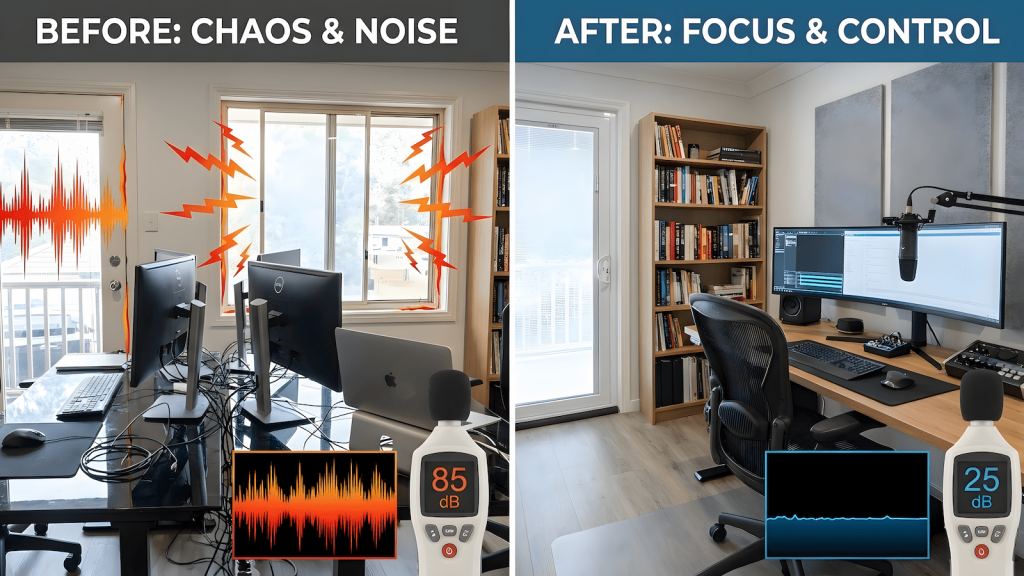
Your office isn’t loud. Your brain just never stops listening.
Road hiss. Distant engines. Wind through gaps. The kind of noise you stopped noticing months ago but never actually stopped tracking. That’s the problem. Not the volume. The constancy.
When the baseline never drops, your brain never resets. Focus becomes effort instead of flow. Music stops being optional and starts being mandatory just to mask the static. Headphones work until they don’t, then they’re just another layer of fatigue.
What you actually want is perceptual silence. Not zero decibels. Not studio isolation. Just a low enough noise floor that your keyboard is audible again and your thoughts don’t have to fight through traffic hum to land.
Silence in a real home office doesn’t mean blocking the world. It means traffic fading into the background instead of sitting on top of your thoughts. It means doorbells, alarms, and abnormal sounds still cut through immediately. Situational awareness stays intact. You’re not isolating. You’re regaining contrast.
That distinction matters if you live near a main road or in dense housing where “just get a quieter space” isn’t an option. Most soundproofing advice assumes large rooms, thick walls, double-pane windows, and suburban buffers. That’s not your reality. You work with physics and constraints, not ideals.
The real issue: noise floor fatigue.
Constant background sound prevents mental reset. Even when you’re not consciously annoyed, your brain is still monitoring it. That passive load accumulates the same way visual clutter and notification overload do. The signal never fully separates from the noise.
This is the same reason a clean signal workspace matters more than piling on tools. A cluttered environment constantly competes for attention, while a clear one reduces background cognitive drag.
If the environment is noisy at baseline, focus always costs more than it should.
That’s why generic advice falls apart. Headphones mask the problem instead of fixing it. Lo-fi and background music add more input when the brain actually wants less. Foam panels and egg-tray myths focus on aesthetics, not the real entry points. Telling people to “just get used to it” ignores how cognition actually works.
Where noise actually enters.
Seal the sliding window first.
In most small home offices facing a road, the sliding window is the primary leak. Not because it’s poorly designed. Because air gaps carry continuous sound extremely well. Seal it properly and something immediate happens: the steady hiss drops while sharp, abnormal sounds still cut through. You’re not muting the outside world. You’re stripping the useless layer that sits on top of everything else.
Weather stripping. Foam tape. Cheap, fast, reversible. Once the window is handled, the room changes character.
Fix the door frame, not the door.
Even a hollow door blocks more sound than people expect. The real leaks are underneath and around the frame. Door sweep at the bottom. Light sealing around the edges. That’s it. Background bleed drops. Sudden sounds still pass. You’re not building a vault. You’re stopping the constant wash.
Add mass where it matters.
Bookshelves filled with books add weight and irregular surfaces that soften sound energy and reduce reflection fatigue. Place them against a road-facing wall. They won’t magically block traffic, but they change how sound behaves in the room. Less sharpness. Less edge. Less long-session strain.
This fits the same control-room mindset explained in your home office is a control room.
The space isn’t decorative. It’s operational.
Use felt panels for reflection, not theater.
Felt panels make sense only after those fundamentals are handled. They’re not there to stop traffic noise. They’re there to stop the room from fighting you. Place them behind monitors or under shelves to reduce harsh reflections that bounce straight back at your head. Over long thinking sessions, that reduction matters more than people expect.
Refine the desk surface.
Hard desks reflect sound upward. You don’t notice immediately, but it adds to fatigue over time. Desk mat or felt pad softens that interaction. Optional. But meaningful once the main leaks are under control.
Why this works: contrast, not absence.
You’re not eliminating sound. You’re lowering the baseline so meaningful sounds stand out again. When the noise floor drops, your brain stops scanning constantly and focus stabilizes without artificial input.
The cognitive cost no one mentions.
Persistent background noise behaves like passive context switching. Even when you think you’re ignoring it, your brain is allocating resources to track it. That invisible tax accumulates the same way constant task switching does.
For the mental-side breakdown of this cost: context switching kills momentum.
No motivation talk. Just bandwidth loss.
The physical cost.
Long-term exposure to low-level noise quietly amplifies fatigue, tension, and headaches during long remote sessions. It compounds other environmental stressors like screen glare and posture collapse.
For the physiological side of this problem: remote work health migraines posture eye strain.
Noise doesn’t need to be loud to be draining. It just needs to be constant.
The takeaway.
You don’t need a silent room. You need a room where the baseline drops, the brain can reset, and important sounds still cut through.
Lower the noise floor first. Everything else comes back online faster than you expect.

WFH Survival Architect • Licensed Procrastination Consultant
Works from a small home office near a main road in the Philippines. Learned noise floor management the hard way through months of traffic hum, AC cycling, and realizing headphones were masking the problem instead of fixing it. Sealed the sliding window first. Everything else followed.
Built RemoteWorkHaven.net for remote workers who need systems that actually work in real constraints not just theory that assumes perfect conditions and unlimited budgets.