Remote work did not invent bad metrics; it simply exposed them to the light of day. When companies moved their operations online, many leadership teams committed the cardinal sin of digital transformation: they simply transported their outdated office-floor logic into digital dashboards. Physical presence on a floor was replaced by screen presence indicators, supervisor walk-by were replaced by invasive screenshot software, and “time in seat” was rebranded as “time logged.” The environment changed fundamentally, but the underlying measurement philosophy remained stagnant, failing to account for the cognitive shift required by remote digital work.
The Origin of the Metrics Wall
In control-heavy remote support systems, metrics are designed to be clear, operationally tight, and unforgiving. These systems operate on the principle of high-volume throughput where Average Handle Time (AHT), offer quotas, call duration, and activity percentages act as the primary pulse of the operation. If an operator exceeds a pre-defined time cap, a notification is triggered; if they dip below activity thresholds for even a few minutes, they are flagged for review. In the context of high-volume, repetitive support roles, these systems provide a necessary level of predictability and scale that keeps the engine running.
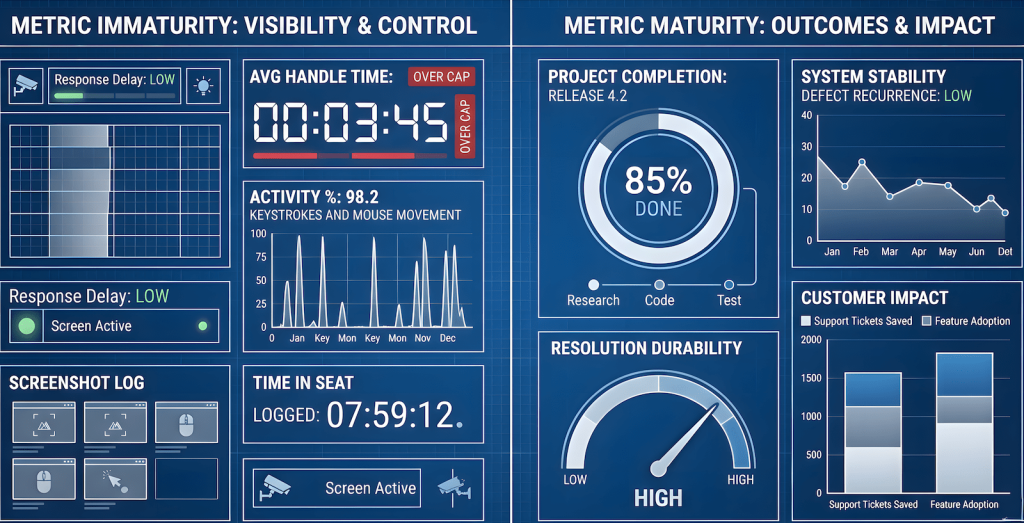
Common metrics found in these “Control-Heavy” stations include:
- Average Handle Time (AHT): Strict limits on how long a single interaction should last.
- Activity Percentage: A ratio of “active” keyboard/mouse time versus total logged time.
- Response Latency: Measuring the exact seconds it takes to acknowledge a new ticket or ping.
- Screenshot Intervals: Random captures of the desktop to ensure “focus” on work-related tabs.
When Visibility Becomes a False Signal
The issue is not that strict metrics exist, but rather the catastrophic friction that occurs when they are copied into environments where the nature of work is fundamentally different. In many software engineering and IT product teams, the visible output is the actual typing and represents only a tiny fraction of the total intellectual effort required to solve a problem. Tasks like debugging complex code, reading documentation, analyzing system logs, mapping architectural dependencies, and mentally simulating system behavior take significant time that does not register as “active” on a traditional tracker. A dashboard may show low keystroke density, and a screenshot might capture a static log file for thirty minutes, while the real work is happening with maximum intensity inside the operator’s head.
The Distortion of Professional Behavior
When visibility becomes the primary performance signal, professional behavior inevitably shifts toward “visible motion” to satisfy the algorithm. Workers are intelligent actors who will always optimize for the metric that determines their job security, even if it contradicts the actual mission of the company. If a system rewards a high activity percentage above all else, the operator will ensure they are moving constantly, often at the expense of the quiet reflection needed for a durable fix. If call duration is punished, they will close tickets prematurely to stay under the cap, even when a deeper resolution would have prevented five follow-up issues.
This distortion manifests in several ways:
- The “Green Box” Obsession: Focusing on keeping status indicators green rather than solving the problem at hand.
- Surface-Level Resolution: Choosing the fastest fix over the most stable one to meet time-based quotas.
- Metric Grooming: Spending a percentage of the workday manually manipulating tasks to look better on a report.
- Incentivized Fragmentation: Breaking large, complex problems into tiny, meaningless “tasks” just to show movement.
The Contextual Mismatch: Support vs. Software
I have worked inside both BPO-style support systems and trust-weighted software engineering teams, and I have seen how the metrics that save one will kill the other. In high-volume support roles, strict metrics align with the nature of the job because service-level agreements (SLAs) require tight, predictable response windows to function. However, applying “Average Handle Time” logic to a software debugging scenario makes zero sense, as a complex defect cannot be solved inside a fixed time box without sacrificing structural depth. Measuring engineering productivity by visible motion is logically equivalent to measuring the quality of a research paper by the author’s typing speed.
Identifying Metric Immaturity
Metric immaturity is not defined by how strict a system is, but by how poorly it aligns with the actual value being created. Immature metrics are obsessed with the “how” and the “when” of the work are the visible markers of a person sitting in a chair. Mature metrics, conversely, focus on the “whats” and the “whys” actual impact to the work has on the long-term health of the system. When the type of work shifts from repetitive tasks to cognitive problem-solving, but the metrics remain immature, the team’s performance will quietly but surely degrade.
The contrast between these two philosophies is clear:
- Immature Metrics: Focus on Time per Task, Activity Percentages, and Immediate Responsiveness.
- Mature Metrics: Focus on Resolution Durability, Defect Recurrence Rates, and Delivery Reliability.
- Impact of Immaturity: Leads to “Productivity Theater” where everyone looks busy but nothing of substance moves forward.
- Impact of Maturity: Encourages “Deep Work” where the focus is on finishing the right thing correctly the first time.
The Hidden Cost of Fragmented Focus
Strict visibility tracking also drastically increases the cost of context switching, which is the silent killer of remote productivity. When workers are pressured to respond instantly to every notification to maintain their activity thresholds, their ability to maintain deep focus becomes incredibly fragile. Each interruption forces a cognitive reset, and over a forty-hour week, these resets accumulate into profound mental fatigue and a noticeable slowdown in progress. This structural cost is explored further in Context Switching Kills Momentum on MomentumPath, which breaks down how repeated resets erode continuity even when the worker’s effort remains high.
Conditioning and the Metric Reaction
In Remote Work Conditioning, I explain how professionals trained in control-heavy systems develop “reflexes” that actually depend on these visible thresholds for a sense of security. When those same professionals enter a trust-weighted environment, the sudden absence of constant measurement can feel less like freedom and more like dangerous exposure. Conversely, those trained in autonomous systems experience the sudden imposition of strict surveillance as a massive professional regression. Leaders must understand these conditioning backgrounds to evaluate whether a team’s resistance to a new metric stems from a lack of skill or a fundamental systemic misalignment.
Conclusion: Trust is a Two-Way Discipline
It is vital to clarify that outcome-based, mature metric systems are not “soft” or “easy” systems; in fact, they often require a much higher degree of internal discipline. Trust-weighted environments demand that the operator be capable of self-regulation and consistent delivery without a digital supervisor breathing down their neck. If the output becomes unreliable or the delivery schedule weakens, leaders will almost always revert to visible tracking out of sheer operational necessity. Trust only scales in a remote environment when the worker’s discipline scales along with the freedom they are given.
Measurement systems will always shape the behavior of the people living inside them. If you choose to measure visible motion, you will get a team that is experts at looking busy while the system slowly rots underneath them. If you measure durable resolution and system stability, you will foster a culture of structural thinking and high-quality output. The question is not whether a remote team should be measured, but whether your metrics have matured enough to match the complexity of the work being performed.

WFH Survival Architect • Licensed Procrastination Consultant
Started in metric-heavy BPO and tech support roles where seconds were tracked and screens were monitored. Later led QA and software teams where outcomes mattered more than activity graphs. Writes about remote systems that reward real work, not dashboard theater.
Built RemoteWorkHaven.net for operators and leaders who want remote performance measured by impact, not keystrokes.
No productivity theater. Just systems that hold under pressure.