Remote work does not fail because people lack talent; it fails because people are trained by different systems and then dropped into environments that require a completely different reflex set. Within the landscape of remote digital work spanning BPO, customer support, VA roles, and high-level software engineering, the actual structure of the workday changes dramatically even though the universal label “remote” remains the same. Two professionals can possess nearly identical years of experience and similar levels of intelligence, yet they may perform completely differently when placed under the exact same remote setup.
The reason for this performance gap is rarely a sudden loss of skill or a lack of work ethic; instead, the root cause is environmental conditioning it’s the invisible psychological and operational habits formed by their previous “work station.”
The Architecture of Control-Heavy Systems
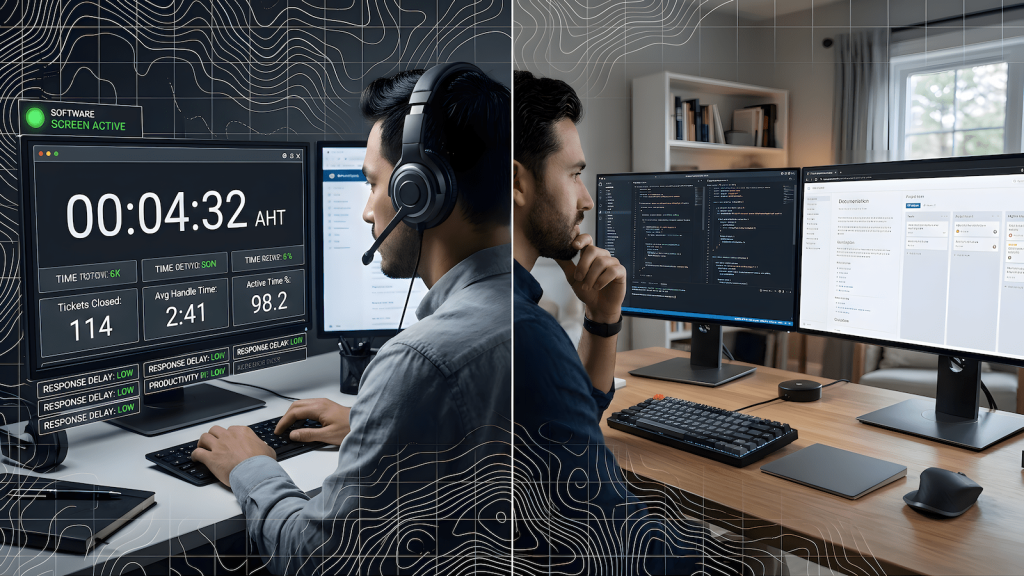
In control-heavy remote systems, such as large-scale call centers, BPO operations, and structured technical support teams, work is primarily measured through constant visibility and granular metrics. These environments define the rhythm of a person’s day through a rigid operating envelope where the data points act as the supervisor. You learn very quickly in these roles that being idle is a significant risk, that exceeding a specific time cap triggers immediate management scrutiny, and that visible responsiveness often matters as much as the actual resolution of a problem.
Over several years, this high-pressure environment trains a specific type of discipline, speed under fire, and a strict compliance with external boundaries.
Common traits developed in these “Control-Heavy” stations include:
- Hyper-Responsiveness: A reflex to answer pings or tickets within seconds to maintain “green” status.
- Metric-Centric Prioritization: Focusing on the quantity of output (tickets closed) over the nuance of the solution.
- External Accountability Dependence: Relying on a manager or a dashboard to signal when it is time to pivot tasks.
- Linear Task Processing: Finishing one clear item before being fed the next one by an automated system.
The Logic of Trust-Weighted Environments
In trust-weighted software engineering and IT product environments, especially within startups or specialized service teams, the structural foundation shifts toward autonomy.
While you may still be expected to log in for a standard eight-hour block to satisfy HR requirements, the true signal of value shifts from constant activity to specific, high-quality output. Research time is considered normal, deep thinking time is not viewed as suspicious idling, and finishing a task ahead of schedule does not automatically mean you must “look busy” to justify your salary.
In these sophisticated software teams, the visible portion of the work like the actual typing of code is often only a small fraction of the total effort required.
In contrast, “Trust-Weighted” stations prioritize:
- Deep Work Capacity: The ability to ignore notifications for hours to solve a complex architectural problem.
- Self-Directed Roadmap: Identifying what needs to be done next without waiting for a ticket to be assigned.
- Outcome Over Activity: Valuing a single elegant solution over ten “band-aid” fixes that meet a daily quota.
- Asynchronous Communication: Understanding that a reply might take four hours because the recipient is “in the zone.”
The Cognitive Shock of System Switching
The fundamental difference between these two structures eventually rewires a worker’s professional behavior and internal biological clock. In a control-heavy system, your primary reflex becomes rapid-fire response and the maintenance of visible motion to satisfy monitoring software. In a trust-weighted system, your primary reflex must shift toward internal pacing, self-governance, and deep, uninterrupted problem-solving. Switching between these two worlds is not merely about learning a new set of project management tools or communication protocols; it is about a total recalibration of what productivity feels like. When this internal recalibration does not happen quickly enough, performance drops precipitously even if the individual remains technically capable of performing the tasks.
The Risk of the “Ambiguity Trap”
A support-trained professional entering a flexible software team for the first time often feels profoundly destabilized by the sudden absence of strict, top-down oversight. Without the constant hum of activity metrics to define whether a day was “good” or “bad,” the working hours can begin to feel dangerously ambiguous and unmoored. Tasks in this new environment require a high degree of self-structuring, where the ability to maintain deep focus for four hours replaces the ability to close forty tickets in the same timeframe. Instead of feeling freed by the newfound flexibility, the person may suffer from chronic uncertainty, constantly questioning if they are doing enough work to justify their position.
Signs that a worker is caught in this “Ambiguity Trap” include:
- Over-Reporting: Sending constant updates on minor progress to prove they are working.
- Anxiety During “Thinking Time”: Feeling guilty or “lazy” when they aren’t actively typing or clicking.
- Analysis Paralysis: Struggling to choose the next task because no one has explicitly assigned it.
- Burnout from “Presence”: Staying online 12 hours a day just to ensure they are seen as “available.”
Unpacking the Comparison Friction
This friction almost always surfaces during team meetings through the medium of comparison, often taking the form of the phrase, “In my old company, we did it this way.” These statements reveal much more than a simple preference for a specific software or workflow; they reveal a deep psychological attachment to a familiar operating model that provided safety. This attachment is entirely understandable because a professional’s identity and sense of worth are built inside these specific systemic “stations” over many years. If you spent half a decade proving your value through strict compliance with rigid metrics, a sudden shift to total flexibility can feel like standing on a crumbling ledge.
The Hidden Cost of Context Switching
One of the most significant hurdles in this adaptation process is how context switching is handled across different remote architectures. In a system that constantly interrupts you with metrics, Slack pings, and visibility checks, the brain eventually learns to perform “shallow” resets very quickly throughout the day.
However, in a deep-focus environment, these same interruptions are catastrophic to the cognitive building blocks required for complex problem-solving. The heavy cognitive tax of tearing down a complex mental model and rebuilding it after an interruption is a very real physical drain that compounds over the work week. A more detailed examination of this phenomenon can be found in Context Switching Kills Momentum, which illustrates how repeated resets can erode an entire day’s progress even when the worker’s effort remains at a maximum.
The Leadership Responsibility in Transition
From a leadership perspective, recognizing this conditioning shift is the difference between retaining a great hire and losing them to “underperformance” within ninety days. When a leader hears an employee repeatedly referencing their previous company’s process, the knee-jerk impulse is often to dismiss that person as being resistant to change or culturally misaligned. While resistance is possible, it is far more likely that the employee is experiencing acute discomfort while their professional reflexes are being forcibly remapped to a new system.
Leaders must realize that process is entirely contextual, and simply hiring for “remote experience” is not enough if the candidate’s conditioning doesn’t match the company’s trust model. This was highlighted in QA Job Post Blew Up, where the massive gap between applicants who followed specific instructions and those who defaulted to their old habits revealed that remote readiness is about operational reflex.
Conclusion: Retraining the Professional Reflex
The ultimate solution to these adaptation issues is not to declare one remote system “right” and the other “wrong,” but to acknowledge that they are different stations requiring different tools. Control-heavy systems remain highly effective for roles that require consistent, high-volume throughput and immediate responsiveness to external stimuli. Trust-weighted systems remain the necessary gold standard for complex product development and high-stakes problem-solving where quality outweighs sheer volume.
The key for both the worker and the leader is to recognize where on this spectrum a person was trained and what the current role actually demands of their focus.
The path to adaptation requires a few specific mindset shifts:
- Audit Your Reflexes: Identify if your habits are based on being “monitored” or being “productive.”
- Define New Success Signals: Ask your lead exactly what “good” looks like in the absence of a dashboard.
- Protect Your Context: If you are in a trust-weighted role, learn to silence the “visibility” guilt and embrace deep work.
- Bridge the Gap: Leaders should provide more structure early on for hires coming from control-heavy backgrounds to prevent the shock of total flexibility.
Recognizing your own conditioning reduces the frustration of the transition and provides a clear map for where you need to grow. While your technical skills can travel across any environment, your professional reflexes must be intentionally retrained to match the station you currently occupy.

WFH Survival Architect • Licensed Procrastination Consultant
Spent years inside control-heavy BPO systems before leading trust-weighted software teams.
Seen remote work from both sides of the metrics wall. This site documents what actually changes performance, and what just looks productive on a dashboard.
Built RemoteWorkHaven.net for operators navigating real-world remote systems, not productivity theater.