You get the rejection email at 10:47 AM. By 2 PM, you haven’t opened your laptop. By Thursday, you’ve missed three application deadlines. By next Monday, your entire job search rhythm is gone.
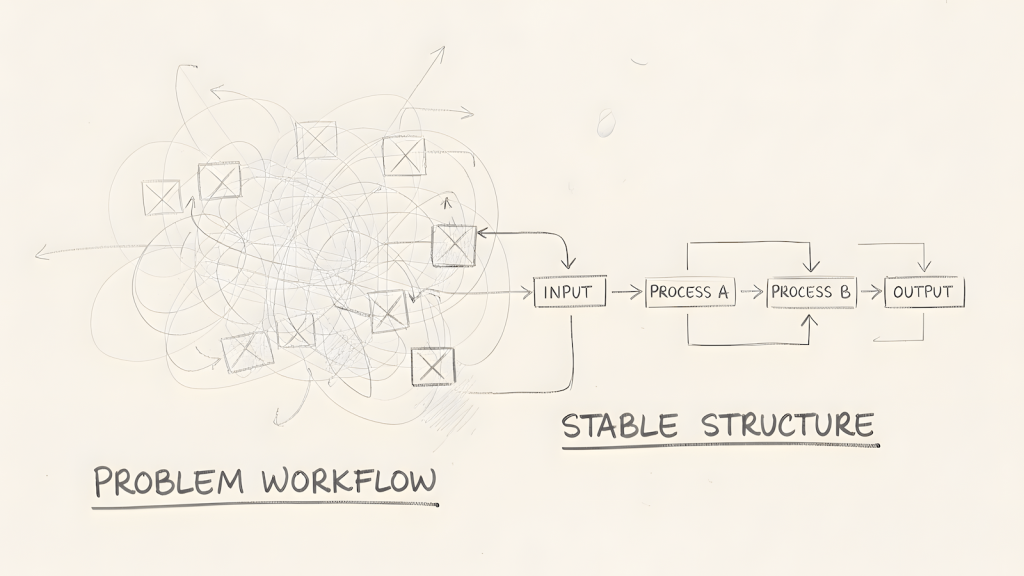
This isn’t about being “too sensitive.” It’s about what happens when your operating system loses structural integrity.
Most advice treats rejection like a feelings problem. It’s not. It’s a systems disruption and remote professionals feel it harder because they’re already operating without external scaffolding.
When you work remote or search for remote work, you don’t have:
- Office structure to force you back into rhythm
- Colleague presence to normalize setbacks
- Physical separation between “work mode” and “failure mode”
So when rejection hits, it doesn’t just sting. It destabilizes your entire operational loop.
Here’s what makes it worse: You often can’t tell what actually caused the rejection. Was it your skills? The impossible job requirements (entry-level positions asking for 3 years professional experience)? An ATS keyword filter? The fact that your personal projects don’t “count” as professional work? You’re reverse-engineering failure from incomplete information which makes the cognitive load even heavier.
What Actually Breaks When You Get Rejected
Rejection doesn’t just hurt. It triggers a predictable system collapse.
Immediate (0-24 hours)
- Momentum loss → you stop mid-task
- Decision paralysis → “should I even apply to this other job?”
- Attention fragmentation → refreshing email, LinkedIn, doom-scrolling
Short-term (1-7 days)
- Schedule drift → your application routine dissolves
- Quality degradation → rush applications to “make up ground”
- Pipeline stagnation → you stop sourcing new opportunities
- Overcorrection → spray-and-pray mode OR total freeze
Medium-term (1-4 weeks)
- Confidence erosion → second-guessing your entire approach
- Isolation amplification → remote search feels even more lonely
- Metric blindness → you lose track of what you’re even measuring
This isn’t character failure. It’s what happens when a load-bearing structure breaks and you have no backup system.
But the collapse pattern looks different depending on where you are in your career and remote work journey.
The Different Collapse Patterns
Fresh Grad / New to the Game
What collapses: Confidence you were still building
You see job descriptions asking for “entry-level candidates with 2-3 years professional experience” or “recent grads with proven track record and 200+ GitHub contributions.” You’ve built projects, created portfolios, learned tools but none of it “counts” as professional experience.
The trap: Every rejection feels like definitive proof you’re not ready, when the real issue is prerequisites that are structurally impossible to meet.
What breaks: Your experimental phase freezes. You stop trying new approaches because you don’t have pattern recognition yet to know what’s signal and what’s noise.
Career Switcher to Remote (Office Veteran)
What collapses: Your old playbook
Everything that worked before—networking, follow-ups, in-person presence operates differently in remote contexts. You have 10 years of transferable experience, but job descriptions ask for “3 years professional experience with Asana” or “proven remote work skills.”
The trap: You can’t tell if you’re being rejected for lack of skills or lack of translation. Your project management experience is deep, but you don’t speak the language of “async communication” and “ownership mindset.”
What breaks: You lose trust in your own experience. A decade of capability suddenly feels worthless because you don’t have the right vocabulary or tool list.
Remote Work Veteran
What collapses: A system you thought was stable
You’ve done this before. You know the remote job search process. But this time, rejections are hitting differently maybe because the market shifted, maybe because you’re carrying fatigue, maybe because isolation is compounding in ways it didn’t before.
The trap: “I should know how to handle this” becomes another source of failure. You used to bounce back faster.
What breaks: Your recovery speed. The system degradation is slower but deeper, because you’re questioning why your proven approach isn’t working anymore.
Old Guard / Generational Shift
What collapses: Your sense of competitive positioning AND your communication confidence
You’re carrying two questions simultaneously:
- “Are my skills actually obsolete?” You see job descriptions filled with tools that didn’t exist 5 years ago. Is your 15 years of project management worth less than someone’s 2 years with Notion and Slack?
- “Am I speaking the wrong language?” They say “async-first” and “synergy” and “move the needle.” They communicate in Slack threads and emoji reactions. Interview norms have changed,energy level, eye contact through a camera, “presence” in video calls.
The trap: You can’t tell which one caused the rejection so you question everything. Was it competence, culture, or age bias? All three?
What breaks: Your ability to calibrate feedback. You don’t know if you need to upskill, translate your value differently, or if you’re fighting invisible age screening. Every recovery action feels like shooting in the dark.
You’re also proficient in tools that work (Photoshop, established methodologies) but the job requires the new equivalent (Figma, “modern” frameworks). Your capability is identical, but the vocabulary mismatch gets you screened out.
The Compounding Effect: Why One Rejection Can Break Your Month
Rejection doesn’t hit once. It hits in waves.
Wave 1: The initial impact
- Disappointment (expected)
- Momentum loss (mechanical)
- Decision paralysis (what do I do next?)
Wave 2: The cognitive spiral (hours later)
- Replay the interview or application (what did I do wrong?)
- Scan for evidence of failure (find it everywhere)
- Project forward (if this didn’t work, what will?)
Wave 3: The behavior change (days later)
- Skip applications you would’ve sent
- Lower your standards OR raise them irrationally
- Avoid job boards (seeing opportunities = feeling failure)
- Delay tasks (because “what’s the point”)
Wave 4: The identity erosion (weeks later, if unchecked)
- “I’m bad at this” becomes “I’m bad at job searching” becomes “I’m unemployable”
- The rejection becomes proof of a pattern, not a single data point
- Your entire job search feels retroactively futile
This isn’t melodrama. This is what happens when your system has no circuit breakers.
The Physiological Reality
What’s happening under the surface: rejection triggers a threat response. Your amygdala hijacks your prefrontal cortex. Blood flow redirects away from complex decision-making. You’re biologically prepared to avoid danger not to make nuanced decisions about your job search strategy.
This is why smart people make poor decisions after rejection. It’s not weakness. It’s physiology. The same mechanism that breaks under deadline pressure breaks under rejection pressure. Your body doesn’t distinguish between “didn’t get the job” and “danger detected.” Both activate the same survival system.
Remote workers experience this more intensely because:
- No colleagues to normalize the experience (“yeah, rejection sucks, happened to me too”)
- No physical separation between “job search space” and “living space” (the rejection follows you everywhere)
- No external structure to force you back into rhythm (office = reset, home = continuous loop)
You know intellectually that rejection is normal. But your system doesn’t care about your intellect. It’s responding to threat signals.
Rejection = uncertain future. Uncertain future = stress response. Stress response = system degradation.
This isn’t about “handling emotions better.” It’s about understanding that your operating system is doing exactly what it’s designed to do under threat and you need different architecture that doesn’t interpret rejection as existential crisis.
Why Standard Advice Fails
“Just keep applying.”
Mechanically true. Structurally useless.
Doesn’t address the bandwidth collapse that makes “just keep going” impossible.
“Rejection is normal.”
Knowing something is normal doesn’t restore your operating rhythm.
Normalization ≠ system repair.
“Don’t take it personally.”
You are the product. Of course it’s personal.
The goal isn’t to pretend it doesn’t land, it’s to contain the blast radius.
“Job search is a numbers game.”
Only works if your system can sustain volume.
If one rejection breaks your week, 100 applications = 100 potential system failures.
The real issue: All of this advice assumes you have resilient infrastructure. Most people don’t. Especially remote workers operating in isolation.
The Recovery Protocol
This isn’t emotional triage. It’s operational reset.
Step 1: Contain the Disruption (0-24 hours)
Your goal: Stop the cascade before Wave 2 hits.
You need to interrupt the threat response before it becomes a behavioral spiral. When your nervous system activates, you have a small window to redirect it before the cognitive spiral locks in.
Don’t:
- Replay the interview or application obsessively
- Apply to 10 jobs to “make up for it” (panic applications = lower quality)
- Doom-scroll job boards (you’re not looking, you’re self-harming)
Do:
Close the loop physically
Move the rejection email to a folder, close the tab, shut the laptop. This isn’t avoidance, it’s creating a clear endpoint so the rejection doesn’t stay “live” in your environment.
Change your context
Different room, different task, different headspace. Your environment carries emotional residue. Reset it.
Use box breathing to reset your nervous system
- Inhale for 4 counts
- Hold for 4 counts
- Exhale for 4 counts
- Hold for 4 counts
- Repeat 4 times
This isn’t about “staying calm.” It’s about regulating your autonomic nervous system so your prefrontal cortex comes back online. You can’t make good decisions while your body is in threat mode.
Re-establish one control point
“Tomorrow at 9 AM, I will [one specific action]. That’s it.”
Not a full recovery plan. Not a strategy overhaul. Just one concrete next step that you can execute regardless of how you feel.
Why this works: You’re interrupting the cognitive spiral before it becomes a behavioral spiral. You’re giving your system a way to exit threat mode and return to operational mode.
Step 2: Audit Without Self-Harm (24-72 hours)
Your goal: Extract signal without amplifying noise.
Before you audit your own performance, acknowledge this: many rejections aren’t about capability they’re about impossible prerequisites, keyword mismatches, or broken filtering systems.
Not every rejection teaches you something useful. Some failures contain actionable data. Some are just broken systems making broken decisions. Your job is to separate signal from noise to log what’s worth learning from and discard the rest.
This is the same approach I use for everything: test, document what breaks, adjust the system, move forward. Stop performing struggle. Start testing systems.
The Rejection Quality Filter
Not all rejections carry the same information.
High-Signal Rejection (Learn from this):
- ✅ You spoke to a human (interview, not just ATS)
- ✅ The job requirements were specific and reasonable
- ✅ You got feedback on a concrete skill gap
- ✅ The interview was conversational, not interrogational
- ✅ You can identify what you’d do differently
Example: “They needed someone with stronger SQL optimization skills. I have basic SQL, but not at the scale they needed. This is actionable, I can learn this.”
Action: Incorporate feedback. This rejection has information.
Low-Signal Rejection (Ignore this):
- ❌ Never spoke to a human (ATS auto-reject)
- ❌ Job had impossible prerequisites (entry-level + 3 years experience)
- ❌ No feedback, or generic “we went another direction”
- ❌ Interview was interrogation-style (prove you’re worthy)
- ❌ You were clearly qualified but rejected anyway
Example: “Applied to ‘Junior Developer’ role requiring 5 years professional experience + portfolio + automation skills. Never heard back.”
Action: File under “broken system.” This rejection tells you nothing about your capability.
Noise Rejection (Structural, not personal):
- 🔸 Tool mismatch (you know Photoshop, they use Figma)
- 🔸 “Preferred” skill you didn’t have became required in interview
- 🔸 Your personal projects didn’t “count” as professional
- 🔸 You didn’t use their exact buzzwords
- 🔸 You were overqualified or underqualified by arbitrary margins
Example: “They wanted ‘Figma expertise.’ I’m a strong designer with Photoshop/Illustrator. I could learn Figma in a week, but I was screened out.”
Action: Adjust language and positioning. This is a translation problem, not a skills problem.
Segment-Specific Audit Questions
Fresh Grad:
- “Was this role actually a good fit, or was I applying to everything?”
- “Am I measuring success by speed (wrong) or by learning rate (right)?”
- “Did I get screened out by ‘professional experience’ requirements I couldn’t possibly meet?”
Career Switcher:
- “Did I frame my experience in remote-work language, or did I sound like an office worker?”
- “Am I clear on what remote hiring actually prioritizes?”
- “Was this a translation failure (I have the skill but not the vocabulary) or a real gap?”
Remote Veteran:
- “Is my system still aligned with current market conditions, or am I running old tactics?”
- “Have I let my pipeline narrow because I got comfortable?”
- “Am I experiencing system fatigue rather than skill decline?”
Older Worker:
- “Was this a skill mismatch, culture mismatch, or age screen?”
- “Did I present myself as adaptable, or did I accidentally signal ‘set in my ways’?”
- “Was I rejected for the skill, or for not knowing the current terminology for that skill?”
If you can’t tell which type of rejection it is: default to “noise” until proven otherwise.
Most people treat all rejections as high-signal (personal failure). This breaks your calibration. You start “fixing” things that weren’t broken.
Step 3: Rebuild the Loop (3-7 days)
Your goal: Restore rhythm, not create new strategy.
The mistake: Thinking you need a new approach, new resume, new everything.
The reality: Your system didn’t fail. Your system got disrupted. You need to restart it, not rebuild it.
How to restart:
- Reduce scope temporarily: Don’t try to “make up” lost time (this creates panic mode)
- Reinstate your smallest repeatable unit: 2 applications/week, 1 coffee chat, 1 skill update
- Separate quality from volume: One good application > five panic applications
- Re-establish your weekly cadence: Same day, same time, same routine
Why this works: Rhythm creates stability. Stability creates confidence. Confidence restores decision-making.
Segment-Specific Rebuild Actions
Fresh Grad:
- Focus on pattern recognition over volume (5 thoughtful applications > 20 spray-and-pray)
- Reframe personal projects with professional framing (add case studies, process docs, simulated constraints)
- Build a knowledge base (track what you learn from each application and rejection)
Career Switcher:
- Focus on one remote-specific tactic per week (learn async communication norms, study remote job descriptions, find remote-work communities)
- Build a translation layer (reframe office experience in remote language)
- Lead with transferable skills, then mention specific tools as learnable
Remote Veteran:
- Focus on system audit over new strategy (What’s degraded? What needs updating? Where’s the friction?)
- Build system maintenance routines (quarterly audits, not just “when it breaks”)
- Acknowledge fatigue as real factor, not weakness
Older Worker:
- Focus on language acquisition alongside skill currency (spend 30 min/week absorbing remote-work discourse not job advice, but how people actually talk in remote contexts)
- Update positioning (remove date markers, use current terminology, emphasize adaptability)
- Separate tool proficiency from skill depth (you have the design thinking; Figma is just the new interface)
Step 4: Strengthen the System (Ongoing)
Your goal: Build rejection-resistance into your infrastructure.
You don’t build rejection-resistance in the moment you need it. You build it beforehand through pre-defined protocols. When rejection hits and your decision-making bandwidth collapses, you need systems that work automatically not strategies you’re figuring out on the fly.
This is the same principle that applies to performing under pressure: pre-built responses work better than real-time problem-solving when you’re stressed. Your resilience isn’t a trait you’re born with. It’s infrastructure you deliberately construct.
How to build it:
1. Pipeline diversity (so one rejection isn’t catastrophic)
- Multiple active applications at different stages
- Mix of “reach,” “match,” and “safe” applications
- Different channels (direct apply, referral, networking)
2. External accountability (breaks isolation loop)
- Weekly check-in with one person (friend, mentor, accountability partner)
- Not for advice, just for presence and normalization
- Remote workers especially need this structural touchpoint
3. Non-job-search wins (restores sense of progress)
- One skill-building action per week (course, project, contribution)
- One networking action that’s NOT tied to immediate job outcome (coffee chat, community engagement)
- These create forward motion when applications stall
4. Pre-defined reset protocols (so you don’t have to think when you’re hit)
- “If I get rejected, I do X” (operational, not emotional)
- Example: “Close laptop, 30-min walk, resume at scheduled time tomorrow”
- This removes decision-making from the crisis moment
Segment-Specific Infrastructure
Fresh Grad:
- Build patience metrics (track small wins, not just offers)
- Build peer accountability group (you’re not alone in the learning phase)
- Create a “prerequisites decoder” (learn to spot impossible job descriptions and filter them out)
Career Switcher:
- Build remote-work fluency (async tools, remote culture, distributed team norms)
- Build mentor access (find people who’ve made the switch successfully)
- Practice translating your experience into remote terminology before you need it
Remote Veteran:
- Build market intelligence routine (stay current on hiring trends, tools, expectations)
- Build recovery speed (pre-define reset protocols before you need them)
- Acknowledge and plan for system maintenance, not just crisis response
Older Worker:
- Build dual-track infrastructure: skill currency + communication fluency
- One modern tool per quarter (not to become expert to signal adaptability)
- Practice current professional dialect (video presence, async communication style, platform literacy)
- Target companies with age-diverse teams (check LinkedIn employee profiles before applying)
The difference: People who recover in 24 hours vs. people who lose a month aren’t tougher. They just have circuit breakers built in.
Architecture, Not Resilience
Rejection will keep happening. That’s not a character judgment, it’s mechanical reality.
But whether it breaks your system is a design question, not a resilience question.
Most people don’t fail at job searching because they’re weak. They fail because they’re running a fragile system under high load with no backup infrastructure.
Remote workers feel this harder because they’re already operating without external scaffolding, no office to force rhythm, no colleagues to normalize setbacks, no physical separation between “work mode” and “failure mode.”
You’re navigating a hiring landscape where:
- Entry-level jobs require years of professional experience
- Personal projects don’t “count” even when they demonstrate real capability
- “Preferred” skills become de facto requirements in screening
- Tool mismatches overshadow transferable expertise
- Age and communication style get conflated with competence
You often can’t tell what actually caused the rejection. So you carry the weight of every “no” as personal failure, when many are system noise.
But you can build a system that doesn’t collapse.
Not because you’re tougher. Because you’ve designed for impact.
That’s the difference between people who recover quickly and people who spiral.
Not character. Architecture.
Related Reading
How Failure Shapes Success: Why Nobody Wants to Hear It
Why cataloging adjustments matters more than romanticizing obstacles. The QA mindset applied to life: test, log what breaks, adjust the system, move forward.
How to Perform Under Pressure: Building Mental Resilience
How your nervous system responds to stress and why rejection triggers the same threat response as deadline pressure. Pre-built protocols work better than willpower when your bandwidth collapses.
The QA Job Post That Blew Up (And What It Taught Me About Hiring)
What happens when you write a job description that doesn’t follow the broken template. Why most job postings create unnecessary rejections before candidates even apply.
Remote Hiring: Interviews as Human Conversations, Not Interrogations
What hiring looks like when you screen for capability instead of keywords. Conversations vs. interrogations and why this approach finds people the broken system misses.

WFH Survival Architect • Licensed Procrastination Consultant
Remote job rejection hits harder because remote work lives or dies by internal structure. I break down the systems behind that collapse so you don’t get blindsided by it again.
Built RemoteWorkHaven.net to help overloaded professionals rebuild reliable work systems without motivation gimmicks or empty advice.

Pingback: Technical Writing Is Not “Just Writing”: Remote Job Reality Check