Most people understand that blogs can generate income. What they don’t understand is how it works without an audience.
Because the traditional model they know requires followers first. Build a crowd, then monetize. That’s how social media works. That’s how YouTube works.
Blogs don’t work that way.
The income doesn’t come from people who follow you. It comes from people who find you once, get what they need, and leave.
Here’s how that actually happens.
The Standing Desk Scenario
Someone types “best budget standing desk under $300” into a search bar. They’re not browsing. Their back hurts. They need a solution before Monday.
They land on your page.
They don’t care who you are. They don’t read your bio. They don’t subscribe.
They skim for what matters:
- Will this desk wobble?
- Does it fit their space?
- Is assembly a nightmare?
- What’s the return policy?
If your page answers those questions clearly, without filler, without asking them to join a newsletter, they keep reading.
If you compare three solid options and explain why one works better for apartments and another works better for dual monitors, they trust the information enough to make a decision.
When they click through to buy the desk, that click carries weight.
Not because you convinced them to want a standing desk. They already wanted one. They already decided to spend money.
Your page just compressed the decision from two hours of tab-switching and review-skimming into five minutes of clarity.
The visitor leaves. The desk ships. You never interact.
But the page did work that mattered, and the economics reflect that.
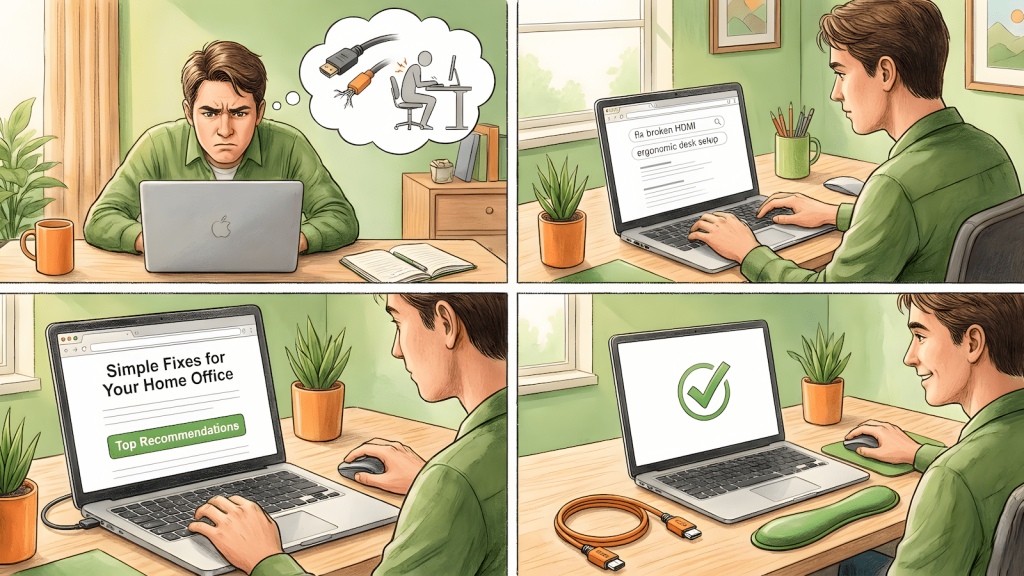
The HDMI Cable Fix
Someone searches “how to fix HDMI no signal on PS5.” They’re not looking for entertainment. Their console isn’t displaying and they’re annoyed.
Your page tells them:
- Unplug the HDMI cable and plug it back in
- Try a different HDMI port on the TV
- Check for a PS5 firmware update
- If none of that works, the cable itself might be the issue
They try steps 1-3. Nothing works.
Now they’re reading the part about cables. And your page mentions that most HDMI issues at 4K120Hz are cable-related, and links to a specific replacement cable that actually supports the spec.
They click it. The cable costs twelve dollars. They were going to buy one anyway. You just saved them from scrolling through forty misleading listings full of fake reviews.
That’s not manipulation. That’s completion.
The page solved a problem. The link was the logical next step. The visitor left satisfied.
And here’s what matters: that interaction didn’t require you to be famous, consistent, or even online.
You could’ve written that page six months ago. You could be asleep right now. You could have three other jobs.
The page still works because it’s built to be found when someone needs it, not followed because someone likes you.
The Mechanical Keyboard Decision
Someone searches “quiet mechanical keyboard for shared office.” They already know they want a mechanical keyboard. They just need one that won’t annoy their coworkers.
They’re not looking for a history lesson on key switches. They’re looking for a recommendation they can trust without doing four more hours of research.
Your page says:
- Brown switches are quieter than blues
- O-rings reduce noise further
- Here are two models under $100 that won’t annoy your coworkers
- One has a detachable cable if you care about that
You just became the most useful thing they read all day.
If that page links to those keyboards, and the visitor picks one and buys it, that’s not a trick. That’s the logical next step.
The link isn’t a detour. It’s the exit door.
What People Miss About This Model
The visitor was already going to buy something. They already opened Google. They already decided to spend money.
Your page didn’t create the need. It compressed the decision.
That’s the part people miss when they think this model is sleazy or manipulative.
You’re not convincing someone to want a keyboard. They already want one.
You’re just making the decision faster and more confident.
And when clarity leads to a purchase, the economics follow.
Not because you begged. Not because you built a parasocial relationship. Because you were useful at the exact moment usefulness mattered.
Why This Works Without Followers
Social platforms pay you to keep people inside the platform. That’s why they reward watch time, engagement, comments, shares. The longer someone scrolls, the more ads they see. You get paid a fraction of that ad revenue if you can keep them glued.
But you’re not the customer. You’re the content. The platform is selling attention to advertisers, and you’re the bait.
Blogs work in reverse.
You’re not keeping people on your site. You’re helping them leave faster, with less doubt.
The visitor doesn’t need to watch three videos and subscribe. They need to click once and move on with their life.
And when that click happens on a page that answered their question, the retailer doesn’t care that the visitor never heard of you. They care that the referral led to a sale.
That’s the entire system.
No followers required. No loyalty required. No one has to remember your name.
You helped someone decide. They bought the thing. The page gets credited. You get a percentage.
It’s not a gamble. It’s just math.
How the Math Compounds
Once you have ten pages that each get a hundred visitors a month, that’s a thousand chances for someone to find what they need and act on it.
You don’t need all thousand to click. You need thirty. Maybe fifty.
And those thirty clicks might generate enough to cover groceries. Or rent. Or the gap between a part-time gig and stable income.
It’s not exciting. It’s not viral. It’s not a story you’d brag about at a party.
But it’s steady.
And steady is what most people actually need when they say they want remote work.
Not an audience. Not fame. Not a brand.
Just a system that works when they’re not performing.
The Standard Is Different
On social media, success is measured by followers, likes, shares, comments. Those are attention metrics.
On a blog built for retrieval, success is measured differently:
Did the page answer the question? Did it help someone decide? Did it hold up?
That’s the standard. And it’s harder in one way, because you can’t fake it long-term. The page either works or it doesn’t.
But it’s also calmer, because the work doesn’t evaporate the moment you stop posting.
A good page from two years ago can still get visited today. Because the problem it solves didn’t expire.
Why This Is Legitimate Remote Work
This isn’t a side hustle. This isn’t passive income fantasy. This is work.
You’re researching products. You’re testing claims. You’re writing clearly. You’re structuring information so someone in a hurry can make a confident decision.
That’s labor. And it’s remote labor.
You can do it from anywhere. On any schedule. Without performing on camera. Without needing followers. Without chasing algorithms.
You write the page. You make sure it’s accurate. You make sure it’s useful. Then you let search do the rest.
The page gets found when someone needs it. It helps them decide. The economics follow.
That’s not a loophole. That’s the business model.
And it works whether you post every day or you haven’t touched the site in a month.
What Makes This Different From “Trial Then Buy”
A lot of content out there is built like a funnel. It’s written like a pitch. It’s optimized like a trap.
That’s not what this is.
Because the real mechanism isn’t persuasion. The real mechanism is intent.
People don’t click because you begged them. They click because you helped them decide.
They arrive already half-decided. They just need someone to cut through the noise and say what matters, what to ignore, and what won’t work for their situation.
When that happens, the link doesn’t feel like a sales pitch. It feels like the exit door.
That’s why this model works for remote income.
It’s not about building an audience. It’s about being useful to people you’ll never meet, at the exact moment they need help making a decision.
Not louder. Not faster. Just steadier.
And if that sounds boring, good. That’s how you know it’s real.
This is part of a series on alternative remote work models:
- Why Content Creation Feels Impossible Without Followers
- Why Blogs Don’t Need Followers to Generate Income
- How Blogs Make Money Without Followers (you are here)
Full transparency: this article contains affiliate links. Which you probably noticed, since we just spent several paragraphs explaining exactly how they work and why they’re there.
If you click one and buy something, RemoteWorkHaven gets a small percentage. You don’t pay extra. The links only show up where they’re actually useful and not random product dumps.
☕ Or support the work directly if you’d rather skip the middleman.